Understanding Play: Why, how, and when play happens
by Dr. Emily A Snowden
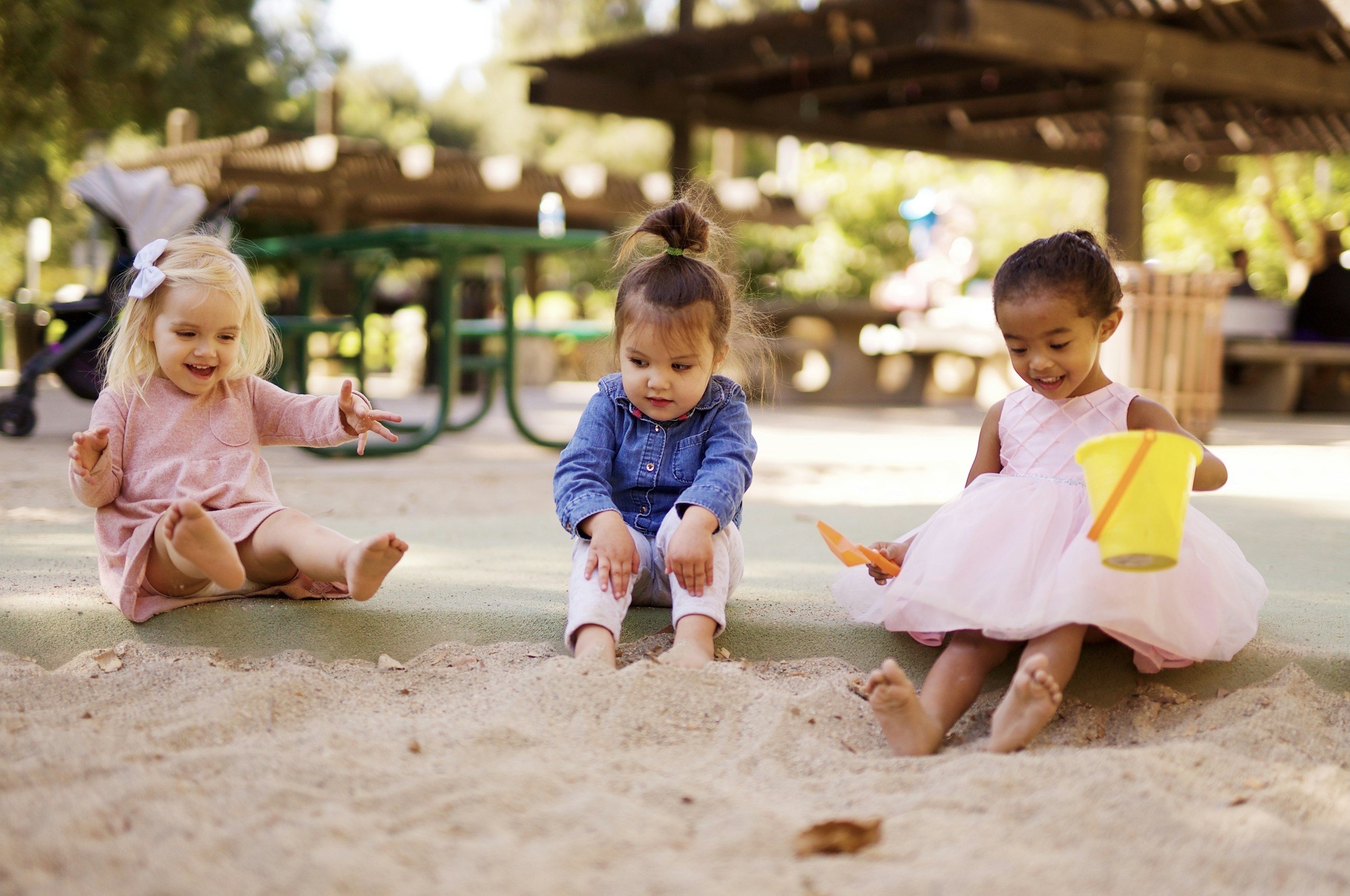
Three preschool-aged children play in a sandbox together.
Despite the ubiquitous nature of play, it remains one of our most misunderstood and underutilized methods of promoting meaningful learning. It is deeply unfortunate that we have this tendency to trivialize play and treat it as a pastime, because it holds enormous potential.
You see, play is more than just a human activity—it is an activity that we see in other animals as well. While we used to think of this as only a mammal behavior, scientists now see that non-mammals play, too. Why?
Defining Play
Play is practice. In this practice, we engage in behaviors we need in “real life.” However, we are not doing so at the moment we actually need them. No, we are doing them in what we call a “low stakes” setting. Holding a baby doll is very different than holding a living, breathing infant. However, when we repeat behaviors like holding, feeding, comforting, clothing, and loving a baby doll, our brains and bodies are more coordinated and practiced when the time comes to really use those skills.
Play has additional functions, too. For one, in this low-stakes setting we can also process events that have happened in the real world. We replay them, practice alternate responses, and take different perspectives and roles through play. This again helps us to coordinate these actions by repeating and exploring them.
Finally, play gives us a chance to bond with each other socially and understand the ways we relate. As we engage in this “pretend world” together, we can understand more holistically the ways we work together in the real.
Sure, board games and “capture the flag” are ways of playing. But, play is much more nuanced. Play is a shape shifter and it can look very different. This is because it is more about how and why we are interacting with something.
Though play is difficult to define and even more difficult to consistently identify, Peter Gray once wrote:
“The characteristics of play all have to do with motivation and mental attitude, not with … the behavior itself. Two people might be throwing a ball ... or typing words on a computer, and one might be playing while the other is not. To tell which one is playing … you have to infer from their expressions and the details of their actions.”
So, play is personal. Play is self-directed. Play is practice. Play is important. It’s no wonder young humans, who are in the midst of a unique and rapid “critical window” of development, can’t help but play.
Types of Play
Now, play can be ambiguous in humans, too. But, we still have identified some pretty consistent forms of play that young children engage in. Some major forms of play include:
-
In pretend play (also known as “Fantasy Play", "Imaginative Play",” and/or “Dramatic Play”), children engage in behaviors that may be real pieces of the world but are not technically “real.” When pretend playing, children let something stand in for something else or take on functions it doesn’t actually have.
Pretend play typically starts around one year of age and becomes increasingly more complex over the preschool years. Young children go from engaging in “real” behaviors like pretending to talk on the phone to more complex and “imaginary” scenarios.
Examples
Playing “house”
Pretending to be in a familiar setting like a grocery store, restaurant, or school
Engaging with play materials like dress up, dolls, tools, or tea party sets
Taking on imaginary roles (and/or settings) like astronauts, superheroes, fairies, royalty, or animals
Benefits
Pretend play cannot be underestimated. When children let the materials and actions in their play stand in as “symbols” they start to develop incredibly important skills that they need in their brains to become thinkers, readers, and self-regulators.
When I understand that this stick is my wand, that transfers into my understanding that this red light means I need to stop the car I’m driving. It is also a key skill in preparing our brains to recognize letters and connect words to real life experiences as we learn to read.
Pretend play also gives children the chance to process roles, routines, and behaviors that they deal with in the real world. As they revisit and represent these things in their play, they grow their understanding.
-
Exploratory play involves the senses and manipulating some sort of stimuli. More simply, this means children are playing with something they can touch, smell, taste, listen to, or explore with their eyes.
Exploratory play may get messy as children practice taking in this sort of information with their senses.
Examples
Sand play
Water tables
Shaving cream color mixing
Drums
Dancing
“Bathtub potions”
Smelling flowers
Benefits
Exploratory play gives children a chance to understand and practice using and really knowing their different senses. This is an important process for them to engage in as they support these parts of their nervous system.
This type of play may also have a calming effect for some children.
-
A back and forth exchange, particularly with infants. These behaviors are seen across cultures as babies “get to know” the members of their community
Examples
Peekaboo
Cooing
Babbling
Singing
Benefits
Attunement play is an important part of establishing bonds with our children. When infants engage in this type of play, they memorize the faces of their caregivers and loved ones. They also start to lay the foundation for concepts like object permanence. In attunement play, children begin to know playfulness and trust.
-
This type of play is exactly how it sounds—children may be rough and they tend to tumble around.
While often spoken about as a behavior between children and their fathers, this type of play can and does happen with other playmates, too.
This is one of the most common forms of play in not only humans but other animals as well.
Examples
Climbing
Wrestling
“Airplane”
Play fighting
Benefits
Rough and tumble play has many obvious physical and social benefits, but a surprising emotional one is that it can also help children learn to regulate their aggression.
It can be hard in our modern society to let this kind of play happen, but we can’t deny how natural it is to development.
-
In movement play, children experiment with body movements. These movements are typically large and repetitive.
This kind of play tones and trains muscles, while also encouraging skills like balance and endurance.
Examples
Jumping
Running
Hopping on one foot
Spinning
Obstacle courses
Chasing
Singing or making repetitive noises
Benefits
Movement or locomotor play is a very important process for children to go through in their brains and bodies as they coordinate these movements and practice executing them as needed.
Like all play, it is important that children choose this themselves. Maybe we can encourage them to practice these skills, but the most meaningful play is chosen and initiated by the child.
-
Object play centers on exploring or “figuring out” a specific item or object. This item may have multiple purposes or functions, or may just be of interest to the child.
Along with attunement play (and movement play), this is one of the first forms of playfulness we see in infants.
Examples
Puzzles
Balls
Shape sorting
“Cause and effect” toys
Play food
Rattles
Benefits
Object play helps children develop their curiosity as they “figure out” and interact with these items.
This type of play also helps children develop the understanding that they have an impact on the world around them with their behavior. Here, they learn the world “extends beyond the self.” -
In constructive play, children practice using materials to build something. This may be real or imaginary, and can look a number of ways.
In this type of play, children are very intentional and tend to base their behavior on a goal that is set through the play.
Examples
Building blocks
“Manga-tiles”
Building with clay or “Play Doh”
Creating a fort
Making a “rocket ship” or “car” from a cardboard box
Legos
Benefits
Constructive play helps children learn to be planners and problem solvers. It also helps them develop their “spatial awareness.”
Constructive play can also encourage creativity (an important facet of problem solving and higher-order thinking!).
-
Storytelling or narrative play involves children telling or acting out events in a known or unknown story.
Children may simply be listeners to stories, or may be active participants in their telling and representation.
Examples
Putting on a theatrical or musical performance
Playing through the events of a movie, book, or television program
Listening to spoken word stories or books
Benefits
Storytelling is one of the most important things humans do to share lessons and knowledge with each other. This reality has been with us for centuries and remains an important part of everyday modern life.
Aside from the cognitive benefits to memory and executive functioning, taking in information in a narrative format is a natural way to let children pick up on important details in the world around them as they practice “perspective taking.”
As they navigate moral and ethical dilemmas humans have faced in real or fantasy life, they become acclimated to the values, language, and important pieces of their culture. This will help them navigate cultural settings and expose them to language in-context that they need to become successful readers. It also helps prompt creativity.
-
One of the “defaults” we tend to go to—games with rules that must be followed for participation.
This type of play is generally more developmentally appropriate for older children, given the demand on their brains to memorize the rules then apply them to their playful behavior.
Examples
Tag
Board games
Red light, green light
Hokey pokey
Capture the flag
Card games
Benefits
Games with rules help children understand how to “juggle” two demands in their brains—the rules or expectations that they have to follow and their behavioral options in that framework. Here, they can also learn to negotiate, cooperate, and solve problems together.
While games with rules highlight this cognitive capacity, it can be frustrating for younger children to coordinate. Try introducing simple games first, with only one rule. If the child becomes frustrated, let them choose something else to play. And remember, play should be their choice. We can encourage play without requiring their participation.
Play in Context
As you can see, the statement that play is diverse, hard to consistently identify, but fundamentally important to development was not an exaggeration! When we’re presented with complex topics about young children, it can be overwhelmingly hard to sift through the information and figure out what to do with it all.

A caregiver splashes in the ocean playfully with a young child.
But, here’s the thing about play–it happens whether we are observing it or not. It is the natural frequency that children are tuned in to. Their brains want to explore the world around them and make unique sense of it, and play is a streamlined learning mechanism that lets them do that and do it efficiently.
Play may be happening in a dramatic display, or it may be as simple as that overstimulating repetitive noise your child is making in the back of the car while you’re stuck in traffic. It may also happen in combination with other types of play or social interactions (social play is a layer we can explore in the future). Fancy toys are not required for them to engage in this process.
However, meaningful play is always an activity that the child is choosing to invest their attention in. This important nuance helps us understand how to encourage playful behaviors in young children without taking it over. They should be the drivers of play, not us.
It’s great to join in on play sometimes, but it’s also important to step back and let children play in the ways that are the most natural and appealing to them in the moment. Here, we can engage in the beautiful practice of taking their lead and seeing the world from their eyes.
When children choose to engage in play, they are choosing the most natural, streamlined, important way to practice and refine their knowledge of the world around them and their influence on it.
“Play is the work of childhood.”