by Muriel Wong
This is the first installment of a five-part series–based on one 1991 document, and forty-five years of watching it hold up
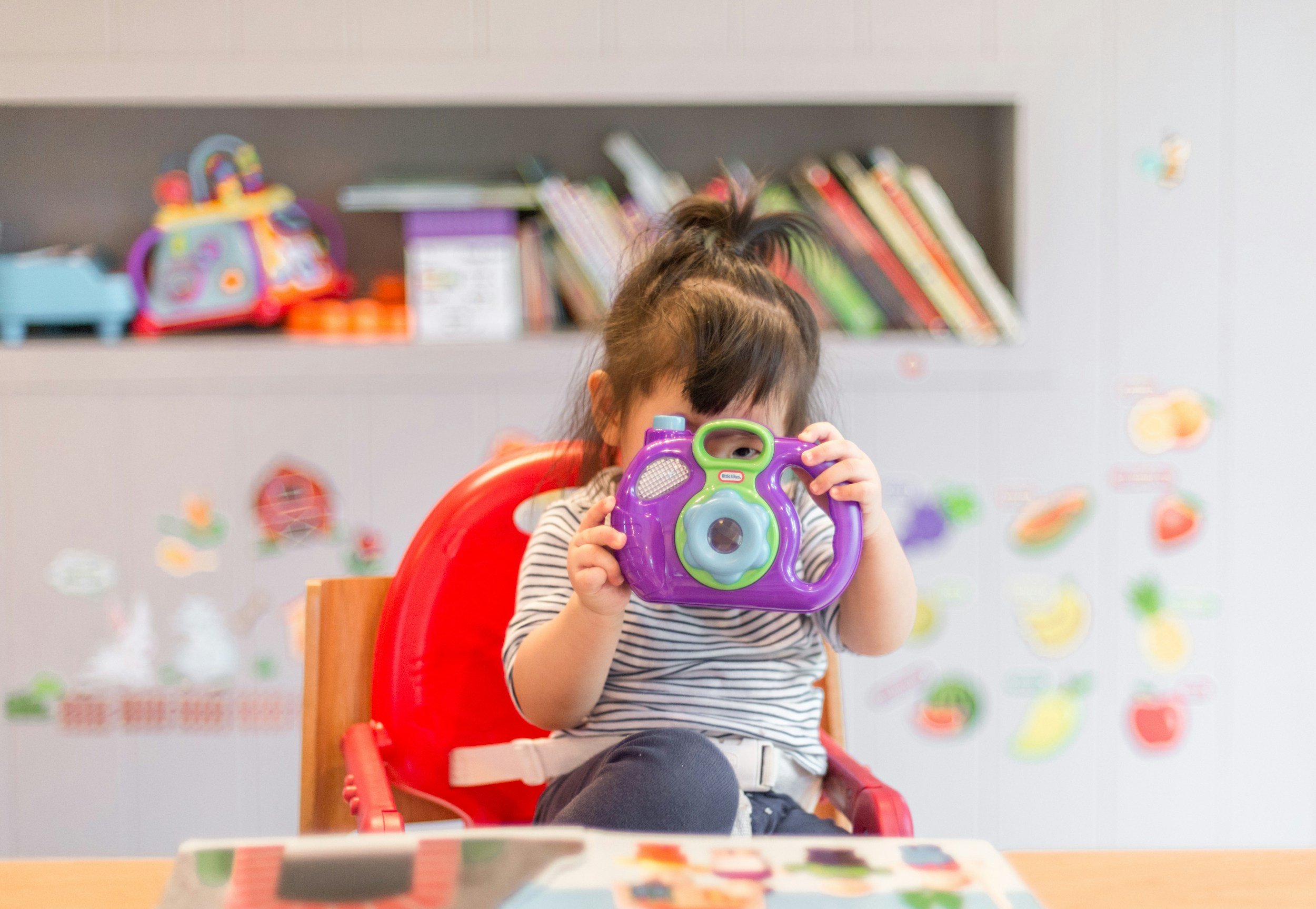
A young child playfully peers at their caregiver through a toy camera.
In forty-five years in early childhood–as a preschool teacher, a director, a parent, a coach, a trainer, and the author of Web-Based Early Learning Systems (WELS)–one document has stayed with me: seven principles I wrote in 1991 for how early learning classrooms should run, for children, families, and staff.
This series is what developed when I set that document next to everything those years taught me, and reflected on what those principles grew into along the way. Each of these five articles was developed based on one 1991 document, and forty-five years of watching it hold up.
I've spent my entire career watching young children up close—long enough now that others in this field consider me an elder. This series is me passing the torch and sharing what actually worked, so it can light the way for whoever picks it up next.
This series is what I have to pass on. I hope it lights something for you too.
As each piece of this series is published, you can read them in sequence or focus on whichever piece answers the question you actually have. Each publication will be accompanied by a printable PDF that you can keep nearby for reference.
Learning from Experience
I have watched children learn for 45 years, and felt when their minds clicked and leapt forward as they took in new bits and pieces of the world and connected them instantly. That “aha” moment comes when children add new learning to what they already know. Think how many more of these moments a child has than we do as adults. It is astounding how much brain development can occur in one day!
I know what the balance needs to be in order for children to be happy and learning. It comes from seeing who a child is, what they do, and how they feel through their eyes, and from intentionally supporting their development, learning, and being.
You can see joy in a child’s whole body: the smile that spreads across their face, the way they lean in to see more, and how they can’t wait to show you what they found. Joy matters because it feeds the spirit. The spirit is what fuels a child’s ability to learn. As a teacher, I learned to see learning through a child’s lens of the world.
As a director, I learned that educators need the same balance. It comes from knowing who they are, their strengths, and what and how they want to learn, so they can grow in their knowledge and in their work with young children. Their well-being was essential too: paid planning time, intentional professional learning, and child care for their own children enrolled in our program as a paid benefit. When educators are happy at school, children feel it. Joy feeds the adults’ spirit too. That understanding has shaped every part of my work since.
Why now?
What worries me now is the push to start earlier and earlier—more school, sooner, as if childhood were something to get through quickly on the way to what matters. I've lived long enough in this field to know that's backwards. What happens in these first years isn't preparation for real learning. It is the real learning, and it shapes everything that follows for the child, their family, and the community around them. Pushing down academics doesn't accelerate a young child. It threatens the very thing that makes the years that follow possible.
Something else has changed since 1991: data. Data can be a real gift to this field as it can show a director, coach, or caregiver what's actually happening for a child, instead of guessing. Much of that data now focuses on the workforce itself. We ask who is teaching? How are they trained? Are they growing in their role? We ask these questions because a child's experience is only as strong as the educator beside them. It matters at every level of the system—for teachers and coaches shaping daily practice, for directors and trainers building a program, and for the policymakers and agencies deciding what gets funded and required.
But data can just as easily become the thing that pushes childhood in the wrong direction, the moment a number turns into a target instead of a signal. Used well, it protects a child's pace. Used carelessly, it can push children faster than they're ready to go. This is exactly why it matters whose hands it's in, and why they're using it.
This series will start by helping you define what DAP is by providing seven basic principles that have remained true over my years in the field.
Play as Inspiration
Picture the block center on an ordinary morning, where two children are building a tower. One is chanting “higher, higher” while the other steadies the base. As they play, they're genuinely working together and negotiating whose turn it is to add the next piece. Even in something so seemingly ordinary, we have cooperation and language happening in the same breath as balance and engineering.

A preschool-aged child plays with blocks.
That block corner didn't happen by accident. In 1991, after years of watching mornings like this one, I wrote seven principles and called them Developmentally Appropriate Practices for Children, Parents, and Staff. I'd been a preschool director for ten years by then, and I wanted something short enough to hand a new teacher on her first day. But it didn't stay a first-day handout. We used it all year, every year—reviewing it, adding what worked, for children, for families, for each other. It became our north star: the thing that deepened our understanding and guided our practice, continually, year after year. What follows is that same set of principles, now sitting alongside what the research has confirmed—and in some places sharpened—in the years since.
So what is DAP, exactly?
Developmentally Appropriate Practice, or DAP, is the framework the National Association for the Education of Young Children (NAEYC) uses to define good early childhood teaching. In plain terms, it's an approach centered on each child's growth, built on their strengths, and delivered through joyful, playful engagement—one that recognizes every child as a whole person shaped by their family and community, not a blank slate. DAP isn't a curriculum you buy. It's a way of making decisions.
NAEYC's current position statement organizes those decisions around three core considerations:
Commonality or what we generally know about how young children grow and learn.
Individuality or the traits and experiences unique to this specific child.
Context or the culture, community, and setting surrounding the child, family, and educator.
Every principle I wrote down in 1991 turns out to be an early, plain-language version of one or more of these considerations. I didn't have that vocabulary then. I had twenty-some years in classrooms and a strong sense of what worked. It's been satisfying to watch the research catch up to that sense.
Seven principles, then and now:
I wrote these seven principles without footnotes, because I didn't need them. I had a room full of three- and four-year-olds telling me, every day, what worked. Decades of research since has mostly done one thing: given language and data to what good early childhood educators already knew in their bones. That's not a small thing. It means the field has gotten more rigorous without losing what it always understood about how young children actually grow.
-
“Curriculum should always have the self-concept and integrity of the child as an underlying goal.” — M. Wong, 1991
Everything else in a program — the letters, the numbers, the field trips — sits on top of whether a child believes they are capable and worthy of belonging. A curriculum that builds skills but erodes a child's confidence has failed at the thing that matters most.
-
“Curriculum should be consistently and culturally representative of the child and family.” — M. Wong, 1991
This is the piece the field has sharpened the most. NAEYC's most recent revision leans much harder into the social, cultural, and historical realities shaping every child's development, and treats equity not as an add-on but as central to what “appropriate” means.
Building a caring, equitable community of learners is still one of the key practice areas NAEYC names outright. A room can't be developmentally appropriate if children don't feel safe in it.
-
“Curriculum should maintain prosocial environments that foster relationships with peers and adults.” — M. Wong, 1991
A child who feels unsafe with the people around them isn't available for learning — the nervous system takes care of that first. Prosocial doesn't mean polite or quiet. It means a room where a child can trust the adults, and where sharing, waiting, and working alongside other children get taught the same deliberate way reading and counting do.
-
“Curriculum should have a rich language component that is based on meaningful experiences and events.” — M. Wong, 1991
Vocabulary flashcards teach words. A real conversation about why the tower keeps falling teaches language — and the reasoning that goes with it. The richest language moments in a classroom rarely come from a lesson plan; they come from an adult narrating, questioning, and genuinely listening during whatever the children are already doing.
-
“Curriculum should always have teaching and learning based on the child as a learner.” — M. Wong, 1991
It's a small shift in wording with a large shift in practice: not "what am I teaching today?" but "what is this child ready to learn today?" The lesson plan serves the child in front of you, not the other way around — which means the same activity can look different in every classroom, and should.
-
“Curriculum should use play as a primary medium for teaching and learning.” — M. Wong, 1991
This is no longer a philosophical stance–it’s an evidence base. Play is a low-stakes, streamlined learning mechanism that is utilized by all mammals. Through play, the brain gets a chance to practice important behaviors that come up in everyday life. Play isn’t an enrichment activity to engage in outside of learning. Play is the mechanism of learning.
-
“Curriculum should incorporate activities where adults can be key role models for play and learning in the classroom.” — M. Wong, 1991
Good early childhood teachers don't stand at the edge of the block corner supervising. They get down on the floor. Recent research keeps landing on the same point: it's the teacher's active presence and thoughtfully set-up play environment that make the difference for learning and social-emotional growth — the adult's role isn't to step back from play, it's to step into it well.
Underneath each of these principles is something even simpler than a framework: joy. A child stacking blocks until the tower holds isn't just building spatial reasoning—she's having a genuinely good morning. If a developmentally appropriate classroom is doing its job, that's not a side effect. That's the point.

A child joyfully plays with paint.
DAP and Early Learning Programs
Families and directors often ask how DAP relates to programs they've heard of like HighScope, Creative Curriculum, Reggio-inspired approaches, Montessori. The honest answer: DAP isn't a competing brand. It's the underlying standard each of those models are trying to meet in their own way. HighScope's plan-do-review cycle, Reggio's emergent curriculum, Montessori's prepared environment. Each is one legitimate expression of the same commonality-individuality-context framework. The question worth asking about any named model isn't simply “is it DAP?” but “how well does it let this specific child, in this specific community, actually be seen?”
What this means for…
-
A classroom full of play is not a classroom without learning — ask your child's teacher what skills a specific activity is building.
Notice whether your family's culture and language show up in the room, not just on a bulletin board once a year.
Look for warm, responsive relationships as much as you look for academics. Both are the curriculum.
-
Before adding a new activity, ask which core consideration it serves: commonality, individuality, or context.
Get on the floor. Your presence inside the play is part of its developmental value, not separate from it.
Revisit your room's materials and stories through the lens of the specific families in front of you, not a generic checklist.
-
Your job is to protect teachers' capacity to do this well — staffing, schedules, and paperwork should serve the classroom, not compete with it.
Program culture is curricular too. A stressed, undersupported staff cannot deliver a warm, responsive room, no matter how good the written plan is.
Center every decision on the families actually enrolled, not an abstract idea of who your families are.
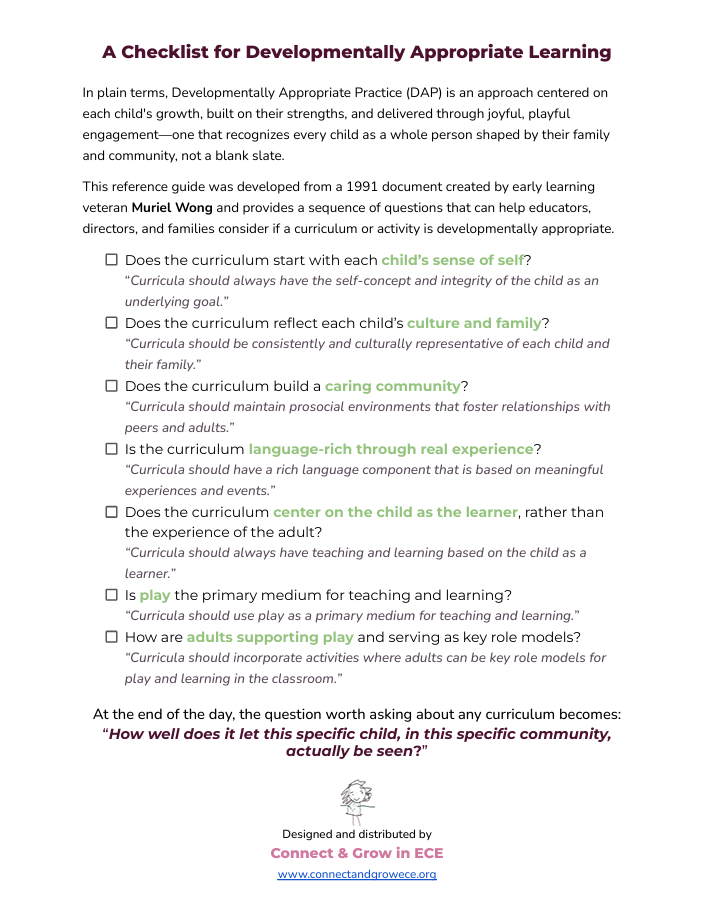
A checklist based on Muriel Wong’s seven principles of DAP.
Click here to download a (free) PDF with this checklist.
Reflections: What Actually Happened in the Room
Everything above is the framework. Below is what actually happened—real memories from thirty-five years of running this room. The three groups mirror the takeaway cards above: proof that DAP wasn't a set of ideas we admired, but a set of practices we lived in, year after year.
Families: To give families choices around their own schedules, once a month we opened two windows — breakfast on Tuesday, or afternoon snack on Thursday. Parents didn't just drop in and leave — many stayed for morning circle, or followed their children out to the playground. It wasn't a special event. It was simply built into the rhythm of the month, often enough that it stopped being a visit and started being part of how the room worked.
Educators: One shift changed how our whole staff saw children: we realized we needed to get on the same page about behavior. So every Wednesday, we met to talk it through — and very quickly, our perspective changed. We stopped asking "what is this behavior" and started asking "what does this development look like." It was a bigger shift than it sounds. Once we reframed behavior through a developmental lens, we saw children differently — not as children misbehaving, but as children developing. Those Wednesday conversations gave every teacher in the building the same understanding and the same starting point with children.
Directors: Our staff was our power. Early on, I learned their work environment had to be built on their strengths, their creativity, and their compassion — for the children and families in their classrooms, and for each other. So that became the priority: paid planning time, every day. Resources on child development, curriculum, and learning. Real professional development. And, most of all, room to let them become the teachers they already were. I stayed close to their practice — sitting in on planning time when I was asked, and on the child development meetings. We worked hard and we played hard. We were devoted to our children, and just as devoted to each other — we truly loved our preschool days as much as our children did.
And when teachers eventually moved on to other schools, what they carried with them wasn't a list of what to teach. It was a deeper understanding of who they were as teachers, and how to see and understand learning and development through a child's eyes.
To this day, I still see early learning through a child's eyes. It has grounded every professional role I've held since—as a trainer, an administrator, an author—each one built on the same understanding I carried out of that preschool.
Originally articulated by Muriel Wong, 1991. Part of the DAP 101 series.
About the Author
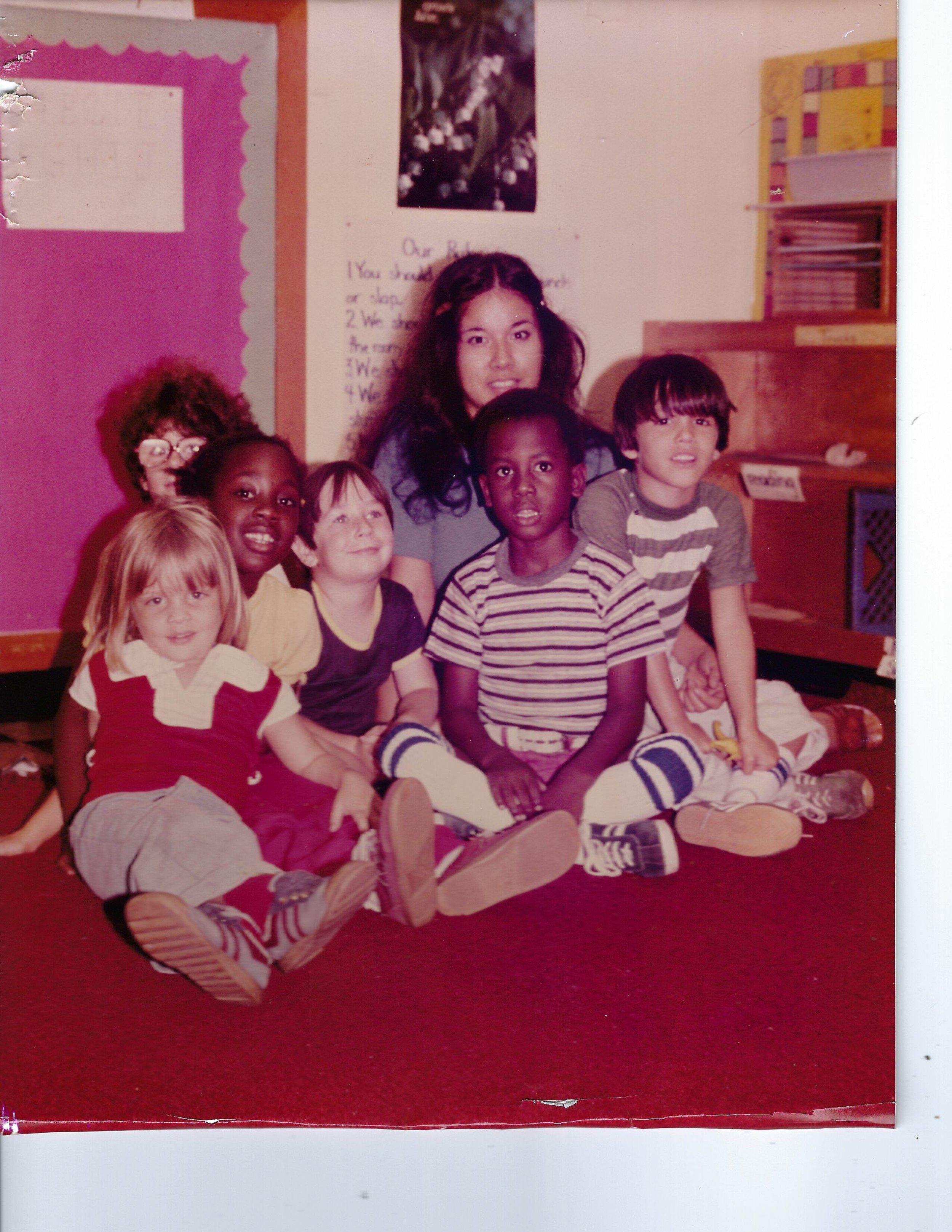
Muriel is pictured here with her “first and best teachers,” her very first Kindergarten class.
From left to right: Nicole, Sabrina, Melanie, Alex, Jamie, and Oscar.
Muriel Wong has spent forty-five years in early childhood education as a teacher, program director, parent, consultant, coach, trainer, and author. She directed the Pre-School Lab at Miami-Dade Community College’s North Campus for twenty-three years, adding the Center for Early Care and Education and leading both together for thirteen of those years.
Throughout her career, to stay close to the classroom, she has also coached early learning programs through accreditation. She led countywide quality improvement and school readiness initiatives and served on NAEYC’s national Governing Board. Muriel is the author of WELS, a web-based data system that supports directors, educators, and coaches in five states and has since grown into its next generation. She has also created Continuous Quality Improvement (CQI) training and led CQI work for agencies and state administrators in multiple states.
Muriel is the mother of two grown children, and raising them while directing the lab shaped how she sees families. In DAP 101, she holds her 1991 seven-principle curriculum framework up to NAEYC’s 2022 position statement on developmentally appropriate practice to see what has endured.
Sources
National Association for the Education of Young Children. (2020). Developmentally Appropriate Practice: A Position Statement.
Størksen, I., Rege, M., Solli, I. F., ten Braak, D., Lenes, R., & Geldhof, G. J. (2023). The playful learning curriculum: A randomized controlled trial. Early Childhood Research Quarterly, 64, 36–46.
Schmitt, S. A., et al. (2018). Using block play to enhance preschool children's mathematics and executive functioning: A randomized controlled trial. Early Childhood Research Quarterly, 44, 181–191.
Schweinhart, L. J., & Weikart, D. P. (1997). Lasting Differences: The High/Scope Preschool Curriculum Comparison Study Through Age 23. Ypsilanti, MI: High/Scope Press.
Bowman, B. T., Donovan, M. S., & Burns, M. S. (Eds.). (2001). Eager to Learn: Educating Our Preschoolers. Washington, DC: National Academies Press.
Katz, L. G., & Chard, S. C. (2000). Engaging Children's Minds: The Project Approach (2nd ed.). Stamford, CT: Ablex.
Bos, B. (1978). Don't Move the Muffin Tins: A Hands-Off Guide to Art for the Young Child. Roseville, CA: Turn-the-Page Press.